


Bitcoin (BTC) once again fell below the $90,000 mark in early Asian trading hours today, despite positive macroeconomic catalysts. An analyst highlighted the drop in stablecoin inflows as a key factor behind Bitcoin’s ongoing weakness, suggesting fresh liquidity is vital for a bullish rally.
The Key Catalyst Bitcoin Needs to Turn Bullish Again
Data from BeInCrypto Markets indicates that December has been a turbulent month for the largest cryptocurrency. Following two consecutive months of losses, Bitcoin experienced its most significant monthly decline of the year in November. As of now, BTC is trading at $89,885, marking a 2.7% decrease over the past 24 hours. This drop is notable, especially given that it occurred shortly after the Federal Reserve’s decision to cut interest rates for the third time this year.
The Federal Reserve lowered rates by 25 basis points to a target range of 3.50%–3.75%. Generally, rate cuts are perceived as bullish signals for the crypto market; indeed, many analysts anticipated a rebound. However, as Bitcoin’s price movements indicate, the expected recovery has not materialized. What does Bitcoin need to shift from this downtrend?
According to the analyst Darkfost, the answer lies in liquidity. The data reveals a significant drop in stablecoin inflows to exchanges, decreasing from $158 billion in August to around $76 billion today. This decline represents a staggering 50% drop over just a few months. Furthermore, the 90-day average of stablecoin inflows has also decreased from $130 billion to $118 billion, highlighting an unmistakable downward trend.
“One of the main reasons why Bitcoin is struggling to recover right now is the lack of incoming liquidity. When we talk about liquidity in the crypto market, we’re primarily referring to stablecoins,”
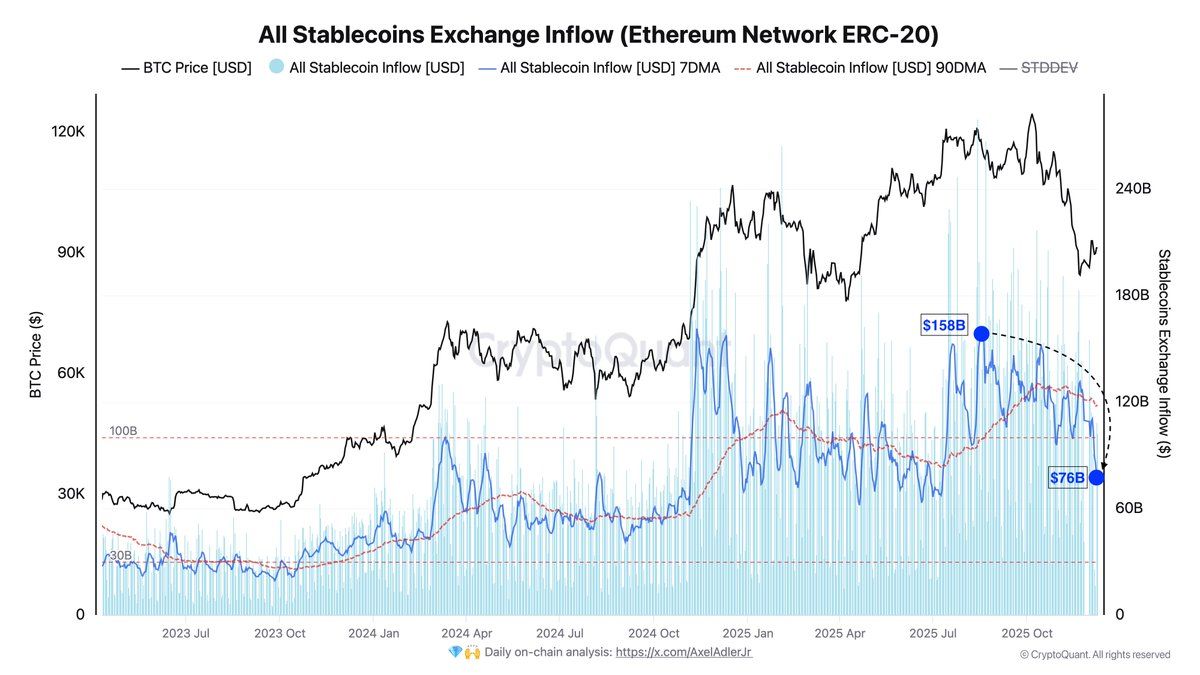
Darkfost further elaborated that the sharp decline in stablecoin inflows signals a weakening demand for Bitcoin. The leading cryptocurrency is now under persistent selling pressure that new capital has not absorbed. Importantly, the current trend shows that minor price rebounds are largely driven by reduced selling rather than revived buying interest.
“For Bitcoin to restart a genuine bullish trend, the key lies in new liquidity entering the market,” Darkfost noted.
Interestingly, a recent report from BeInCrypto cited that stablecoin issuers are continuing to mint new tokens, with the market capitalization of major assets like Tether (USDT) and Circle’s USDC reaching new highs this month. However, despite this news, data illustrates that much of the supply is being absorbed for cross-border payment needs. A notable portion of inflows is also directed toward derivatives exchanges rather than spot platforms.
“Asia leads with the highest volume of stablecoin activity, exceeding North America. Relative to gross domestic product, though, Africa, the Middle East, and Latin America stand out. Most of the flow is from North America to other regions,” the IMF wrote in a recent report.
Thus, Bitcoin’s recent decline underscores that macroeconomic factors alone are insufficient to drive the market. Current data clearly indicates that a revival of stablecoin liquidity is a crucial missing element for a sustained bullish reversal. Additionally, market sentiment remains restrained; fear-driven behavior and low engagement continue to hinder capital rotation into Bitcoin.